
When something goes wrong with a dog’s digestion, the first question is almost always about food. What is being fed? Could it be the protein source? Should the food be changed? Is the diet balanced enough? These are reasonable questions. Food is the most visible input into the digestive system and it is a logical place to start.
But food is not where gut health begins. Food is what the gut has to process, and the environment doing the processing decides how well that goes. Gut health is expressed further down, in the stool, the coat, the energy, and the steadiness. The foundation sits underneath all of it, and understanding where it actually starts changes what it means to support it.
What Is Upstream of Food
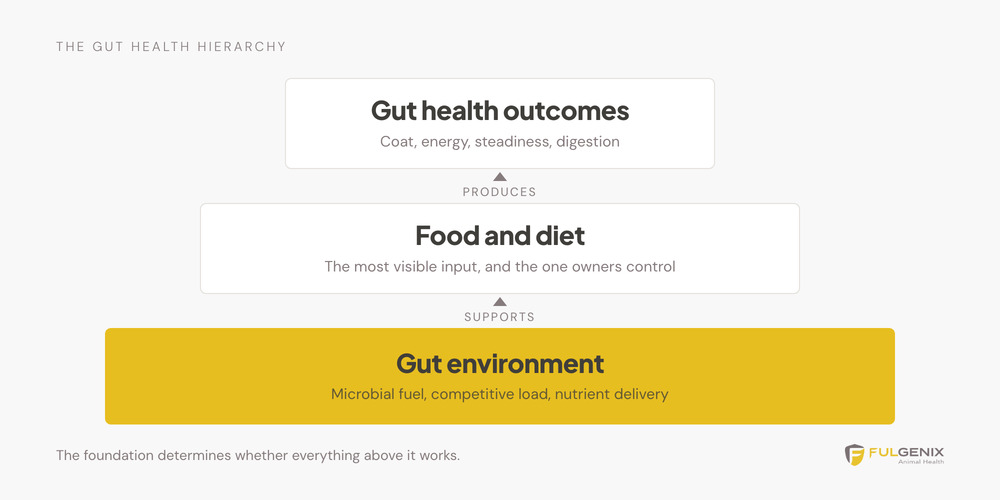
The food a dog eats enters a gut ecosystem. That ecosystem either has the conditions to process the food effectively, or it does not. High-quality food entering a depleted gut environment delivers less benefit than the same food entering a well-supported one. The environment determines the outcome. The food is the input, but the environment is what processes it.[1]
Gut health therefore begins with the conditions of the gut environment: the stability of the microbial community, the availability of the microbial fuel that sustains it, the presence or absence of pathogens and toxins that compete with beneficial bacteria, and the efficiency of the nutrient delivery mechanisms that determine what the body actually receives.
These conditions exist before any food is consumed. They are the infrastructure that food, probiotics, and all other gut health inputs depend on. It is the difference between the seed and the soil. You can choose an excellent seed, but what it becomes is decided by the ground it lands in. Food is the seed. The gut environment is the soil, and the soil is upstream of everything the seed can do.
Why the Food-First Instinct Is Incomplete
None of this makes food unimportant. Diet matters, and a poor diet can absolutely compromise a gut. The point is that food is one layer of a multi-layer system, and it is the layer owners can see, which is why it gets all the attention.
When a dog has a recurring issue and the response is to keep changing food, the owner is working the most visible lever while the decisive one stays untouched. Sometimes a food change helps, because the new food happens to suit the environment a little better. Often it produces a brief improvement followed by a return to the same pattern, because the environment that struggled with the last food is the same environment receiving the next one. The repeated food trial is really a search for an input that the environment can tolerate, when the more durable answer is to improve what the environment can tolerate in the first place.
This reframes the familiar advice to find the right food. The right food is genuinely worth finding. But for a dog whose gut keeps struggling, the right food works far better, and lasts far longer, when the environment receiving it has been supported.
Where the Depletion Begins
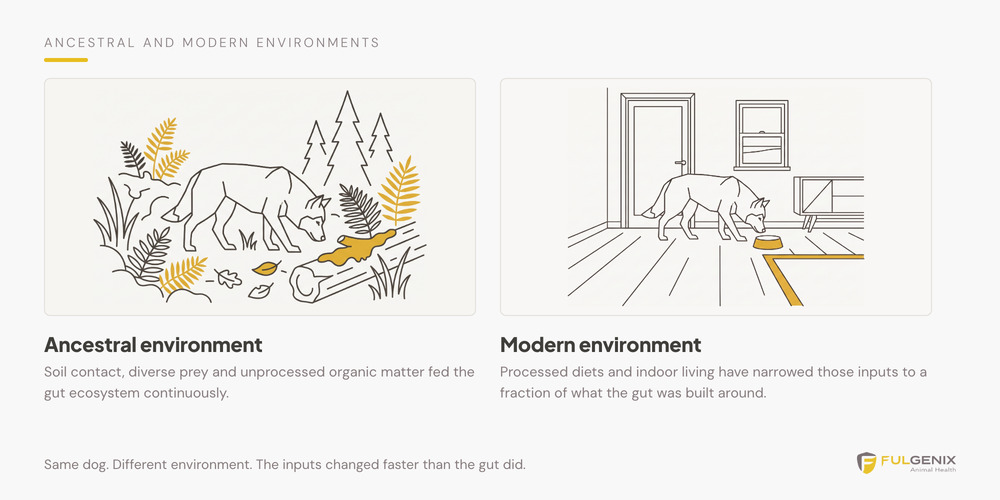
Dogs evolved in environments rich in organic inputs, diverse prey, soil contact, unprocessed organic matter, and the humic substances that form the foundation of healthy biological systems. These inputs naturally supplied the gut with bioavailable carbon and other compounds that supported the microbial environment from the ground up.[3]
Modern dogs live differently. Processed diets, indoor environments, reduced exposure to organic matter, and routine antibiotic use have progressively narrowed the inputs available to the canine gut ecosystem. The result is a gut environment increasingly depleted of the foundational materials beneficial bacteria depend on.[2]
This depletion is gradual and largely invisible. It does not announce itself with a single dramatic symptom. It shows up as a gut that is a little less resilient than it should be, a dog that reacts to things it once handled, a baseline that has quietly drifted. Because it develops slowly and beneath the surface, it is easy to attribute the resulting issues to the most recent food rather than to the long erosion of the environment that food enters.
Supporting the Foundation
Gut health begins by addressing the environmental conditions that determine whether the gut can function as it was designed to. Bioavailable carbon supplies the microbial fuel the ecosystem depends on. Compounds that bind and clear pathogens and toxins reduce the competitive load working against beneficial bacteria. And support for nutrient delivery mechanisms ensures that what a dog eats actually reaches the tissues that depend on it.
When these foundational conditions are present, everything else, food quality, probiotic support, veterinary care, can deliver its intended benefit. When they are absent, even the best inputs enter an environment that cannot fully use them.
Fulgenix fuels beneficial bacteria with bioavailable carbon, humic acid binds pathogens, heavy metals, and toxins so they cannot compete or cause harm, and fulvic acid delivers nutrients from the gut directly into the bloodstream and to cells.
The practical effect of supporting the foundation is that the other decisions get easier. A food transition is tolerated more smoothly. A probiotic given during a rough patch actually holds. Nutrients from a good diet are absorbed more completely, which tends to show up in the visible markers owners care about, coat, energy, and steadiness. None of these are separate wins. They are what happens when the layer beneath food is working.
Starting in the Right Place
For a dog owner, beginning with the environment is not a rejection of good nutrition. It is putting the layers in the right order. Choose good food, work with your veterinarian, use a probiotic when it is warranted, and support the environment that determines whether any of it lands. Owners who start in that order tend to spend less time cycling through foods and supplements, because they are no longer asking a single input to fix a problem that lives a layer beneath it.
That is where dog gut health actually begins. Not with the next bag of food, but with the conditions the food depends on.
The Layers, in the Order They Matter
It helps to see the whole system as a set of layers, because the order is what most approaches get wrong. At the surface is the symptom, the loose stool or the off day, which is what prompts action. Just beneath it is the food, the most visible input and the usual first response. Beneath the food is the gut environment, the conditions that decide how the food is processed. And beneath the environment are the foundational inputs the environment itself depends on, the microbial fuel, the cleared competitive load, the delivery mechanisms.
Conventional gut care works from the top down, starting at the symptom and rarely getting past the food. The environment-first approach works from the bottom up, securing the foundation so that the layers above it can do their jobs. Both touch the same system, but they start at opposite ends, and where you start determines whether you are managing the surface or addressing the source. A dog whose foundation is supported tends to need less intervention at the surface, because fewer problems reach the surface in the first place.
What Changes When You Start With the Environment
Owners who reorder these layers, environment first, then food and the rest, usually describe a quieter relationship with their dog’s digestion. The constant small adjustments, the latest food trial, the supplement added in response to the most recent flare, give way to a more stable baseline that simply needs less management. It is not that nothing else matters. It is that the other inputs finally have a foundation solid enough to build on, so each one delivers more and lasts longer.
This is especially true for dogs with a history of recurring issues, where years of food-first management have produced a long series of partial fixes. For these dogs in particular, beginning at the foundation is often the change that finally moves the baseline rather than the symptom. The food still matters, the veterinary care still matters, but they start working with the gut rather than against an environment that could not support them.
A Practical Starting Point for Owners
Putting the environment first does not require overhauling everything at once. It starts with a simple reordering of attention. Keep the good food you have chosen and the veterinary relationship you rely on, and add support for the gut environment as the foundation beneath them rather than as one more thing to try when something goes wrong.
In practice that means treating the environment as a constant rather than a reaction. Food trials, supplements, and interventions tend to be episodic, introduced in response to a problem and dropped when it passes. The environment, by contrast, benefits from consistent support, because it is a living system that holds its gains only while the conditions that produce them are maintained. A dog whose environment is supported steadily is a dog whose food works better, whose occasional probiotic actually holds, and whose ordinary disruptions cause less trouble.
For owners who have spent a long time searching for the right food or the right supplement, this is often a relief rather than a burden. It replaces a frustrating sequence of single fixes with one foundational habit that makes the rest of their choices more effective. The question stops being which product to try next, and becomes how to keep the gut environment in the condition that lets everything else do its job. That is a calmer, more durable way to care for a dog’s digestion, and it is where the lasting results come from.
FAQ
Does dog gut health really start before food?
Yes. Food is the most visible input into the digestive system, but the gut environment that processes that food was established long before any individual meal. The environmental conditions inside the digestive tract, including microbial fuel availability, competitive load from pathogens and toxins, and nutrient delivery efficiency, determine how effectively food is processed and what outcomes it produces. Improving food quality matters, but it works best when the underlying environment is also supported.
Why can a dog eat an excellent diet and still have digestive issues?
A high-quality diet enters a pre-existing gut environment. If that environment is depleted of microbial fuel, carries a high competitive load from pathogens and toxins, or has compromised nutrient delivery mechanisms, even well-chosen food cannot produce the outcomes it should. The environment determines how effectively the diet is used, not the food in isolation.
What does the gut environment actually include?
The gut environment refers to the internal conditions inside the digestive tract: the stability of the microbial community, the availability of bioavailable carbon as microbial fuel, the presence or absence of pathogens and toxins that compete with beneficial bacteria, and the efficiency of the nutrient delivery mechanisms that determine what the body receives. These conditions exist before food enters and determine how food is used once it does.
If I keep changing my dog’s food, why does the problem keep coming back?
Repeated food changes work the most visible lever while the decisive one, the gut environment, stays untouched. A new food may suit the environment slightly better and produce a brief improvement, but the environment that struggled with the last food is the same one receiving the next. Supporting the environment is what lets a chosen food finally produce a lasting result.
How did dogs historically maintain a healthy gut environment?
Dogs evolved in environments rich in organic inputs, diverse prey, soil contact, unprocessed organic matter, and the humic substances that form the foundation of healthy biological systems. These inputs naturally supplied the gut with bioavailable carbon and other compounds that supported the microbial environment from the ground up. Modern processed diets and indoor living have significantly reduced those inputs, which is why supporting the gut environment directly has become relevant.
What is the right order to support my dog’s gut?
Put the layers in sequence. Choose good food, work with your veterinarian, use a probiotic when it is warranted, and support the gut environment that determines whether any of those inputs land. Starting with the environment does not replace the others. It is the foundation that lets them work, which is why beginning there tends to reduce the cycling through foods and supplements that many owners experience.
References
[1] Suchodolski, J.S. (2011). Intestinal microbiota of dogs and cats: a bigger world than we thought. Veterinary Clinics of North America: Small Animal Practice, 41(2). https://pubmed.ncbi.nlm.nih.gov/21486637/
[2] Guard, B.C., et al. (2015). Characterization of microbial dysbiosis and metabolomic changes in dogs with acute diarrhea. PLOS ONE, 10(5), e0127259. https://pubmed.ncbi.nlm.nih.gov/25992794/
[3] Kuzyakov, Y. & Blagodatskaya, E. (2015). Microbial hotspots and hot moments in soil. Soil Biology and Biochemistry, 83. https://www.sciencedirect.com/science/article/pii/S0038071715000814