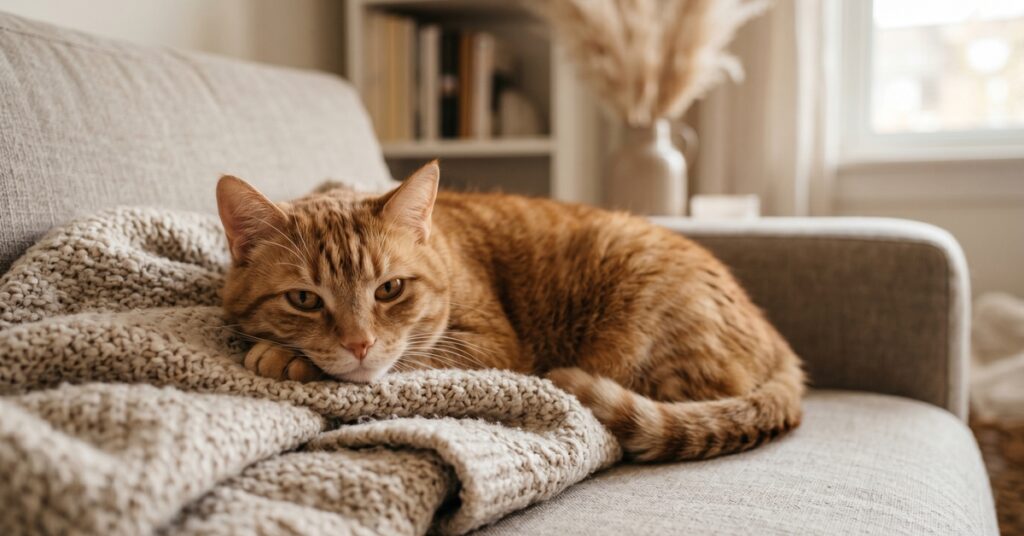
There is a particular kind of frustration that comes with managing a cat that never quite settles digestively. Not dramatically unwell. Not in obvious distress. But never fully stable either. Stool that varies without clear reason. Appetite that fluctuates. A gut that seems to tolerate things for a while and then does not.
Many cat owners come to accept this as simply their cat’s nature. A sensitive system. A delicate constitution. Just the way this particular cat is.
But chronic digestive instability in cats is not a personality trait and it is not inevitable. It is a biological pattern with a biological cause. Understanding the cause is what makes it possible to actually address it.
[IMAGE: hero]
What Recovery Actually Requires
When a cat experiences significant digestive disruption, an infection, antibiotic treatment, a diet change, a period of heightened stress, the gut ecosystem is disturbed. The acute episode eventually passes. But passing is not the same as recovering. The real question is whether the conditions exist for the ecosystem to rebuild itself, not just for the immediate symptoms to fade.
This distinction is the heart of the problem. Owners and products tend to measure success by the disappearance of symptoms. The stool firms up, the appetite returns, and the episode is declared over. Underneath, the gut environment may still be depleted, still carrying an elevated competitive load, still short of the fuel its bacterial community needs to fully re-establish. The cat looks recovered while the environment that determines its stability has not actually been restored. The next challenge then lands on a foundation that never fully rebuilt, and the instability returns.
Why Cats Are Particularly Prone to Incomplete Recovery
In cats, recovery from gut disruption is made harder by several biological factors working together.
The naturally lower microbial diversity of the feline gut means there are fewer alternative species to compensate when beneficial populations are reduced. Where a more diverse gut has understudies ready to take over a disrupted job, the feline gut has fewer, so a knock to one population is felt more directly and is harder to absorb.
The faster transit time compresses the opportunity for microbial re-establishment. Organisms trying to regain a foothold have a shorter window in which to do it before they are carried through, which slows the rebuilding of a disrupted community.
And the feline gut-brain axis means stress, which often accompanies health challenges, can perpetuate the disruption independently of whatever caused it initially. A cat unsettled by illness, a vet visit, or a change in routine carries that stress into its gut, where it can keep the ecosystem off balance even after the original trigger has resolved.[1]
[IMAGE: aha]
The Concealment Problem
Cats are also exceptionally skilled at concealing digestive discomfort. This biological tendency, rooted in the survival instinct to mask vulnerability, means owners often cannot observe how compromised the gut environment has become until the instability is well established. By the time visible symptoms appear, the underlying environment has often been in a depleted state for considerably longer.[2]
This creates a particular challenge. Interventions tend to be introduced late, after the gut environment has already been compromised beyond the point where simple population-level interventions can restore stability on their own. The probiotic or food change that might have helped earlier now enters an environment too depleted to make use of it, which is part of why these tools so often produce a brief improvement and then fade.
The concealment problem also distorts how owners read recovery. Because a cat hides discomfort, the return of normal-looking behaviour can arrive well before the environment has actually rebuilt. The cat appears fine, the support is eased off, and the still-fragile environment is left to face the next disruption without the conditions it needed to finish recovering. The cycle is not a sign of a uniquely difficult cat. It is the predictable result of judging a concealed, slow-rebuilding system by its surface.
[IMAGE: supporting]
The Cycle, Step by Step
It helps to see the pattern as a sequence rather than a run of bad luck. A disruption knocks the feline gut ecosystem out of balance. Symptoms appear, often later than the underlying change because the cat conceals them. Something is tried, a probiotic, a food change, time, and the symptoms ease. The intervention is judged a success and withdrawn. But the environment, with its low diversity, fast transit, and lingering stress load, never fully rebuilt, so when the next ordinary challenge arrives, a diet change, a stressful weekend, a minor illness, the ecosystem tips again with less provocation than before. Each pass through the cycle can leave the baseline slightly lower, which is why a cat can seem to grow more sensitive over time rather than less.
Breaking the sequence means intervening at the step everyone skips: restoring the environment so the recovery is real rather than apparent, and maintaining it so the next challenge meets a gut that can absorb it.
[IMAGE: mechanism]
What Full Recovery Requires
For a cat to fully stabilise after digestive upset, the gut environment itself must have the conditions for recovery. This means adequate microbial fuel, reduced competitive load from pathogens and toxins, and efficient nutrient delivery mechanisms. When those environmental conditions are restored, the gut ecosystem has what it needs to re-establish balance, and to maintain it when the next challenge arrives.
Fulgenix fuels beneficial bacteria with bioavailable carbon, humic acid binds pathogens, heavy metals, and toxins so they cannot compete or cause harm, and fulvic acid delivers nutrients from the gut directly into the bloodstream and to cells.
What Genuine Stability Looks Like
When the environment is supported rather than just the symptoms managed, the change a cat owner notices tends to be quiet and cumulative, which suits a species that hides its discomfort in the first place. The first sign is usually consistency: stool that holds its form day to day, an appetite that stops swinging. The more meaningful sign, over a longer stretch, is resilience. The diet change or stressful event that used to set off days of upset is absorbed with less fallout and a faster return to normal.
That resilience is the real marker of recovery, because it shows the ecosystem has regained its ability to regulate itself rather than simply having its latest flare suppressed. For an owner who has spent a long time accepting a sensitive cat as a fixed fact, the shift from managing recurring episodes to maintaining a stable baseline is often the clearest evidence that the right layer, the environment, is finally being addressed.
Why Stress Keeps the Cycle Going in Cats
Stress deserves particular attention in cats, because it is one of the main reasons feline recovery stalls when it would otherwise complete. The feline gut-brain axis is unusually responsive, which means a cat’s emotional state and its gut are in close, two-way communication. A stressor that a more robust system would shrug off, a houseguest, a change in routine, a new pet, a move, can register directly in the gut and keep an already disrupted ecosystem from settling.
This matters because the events that disturb a cat’s gut in the first place tend to come bundled with stress. Illness is stressful. A vet visit is stressful. A diet change imposed during a rough patch is stressful. So at the very moment the gut is trying to rebuild, it is often being asked to do so under a stress load that actively works against re-establishment. The result is a recovery that keeps getting interrupted before it can finish. Supporting the environment does not remove the stressors from a cat’s life, but a gut with adequate fuel, a cleared competitive load, and efficient delivery has more capacity to absorb them, so an ordinary stressful stretch is less likely to reopen a cycle that was close to closing. It also helps to recognise that the stress and the gut feed each other: an unsettled gut can leave a cat more on edge, and a more on-edge cat is harder on its gut. Giving the environment what it needs is one of the few places an owner can intervene that quiets both sides of that loop at once rather than chasing each in turn.
Supporting Recovery Before the Next Challenge
The most useful shift for an owner of a cat that never quite stabilises is to stop treating gut support as something introduced only when symptoms appear, and to start treating the environment as something maintained between episodes. Because a cat conceals discomfort and its gut rebuilds slowly, the gap between episodes is precisely when the environment most needs support, even though nothing looks wrong. That is the window in which a depleted environment can actually finish recovering rather than being left half-restored until the next disruption exposes it.
In practice this means keeping the good food and the veterinary relationship that already work, and adding consistent support for the gut environment underneath them rather than reaching for a new product each time something flares. Interventions aimed at the population are episodic by nature, introduced in response to a problem and dropped when it passes. The environment, by contrast, is a living system that holds its gains only while the conditions that produce them are maintained. A cat whose environment is supported steadily is a cat whose recovery from any single upset is more likely to be complete, and whose next challenge lands on a foundation that can take it. For an owner used to a sensitive cat lurching from one episode to the next, that steadier footing is usually the change that finally moves the baseline rather than the symptom.
The information in this article is intended for educational purposes only. Fulgenix products are designed to support digestive health and are not intended to diagnose, treat, cure, or prevent disease. Please consult your veterinarian for specific health concerns related to your pet.
Written by Leah Oram, Co-Founder of Fulgenix and The Carbon Biome Project.
FAQ
Why does my cat keep having the same digestive issue come back?
Recurring digestive instability is usually a sign that the gut environment never fully recovered from an earlier disruption. The acute episode resolves, but if the environment was already depleted of microbial fuel or carrying an elevated competitive load, the conditions that allowed the disruption persist. In cats, the naturally lower microbial diversity of the feline gut means there are fewer alternative species to compensate, so the same triggers that the cat once tolerated can produce instability again.
Is a sensitive stomach just my cat’s nature?
A reactive gut is a biological pattern, not a fixed personality trait. When a cat improves and then regresses repeatedly, it usually reflects the state of the gut environment rather than something inherent to the cat. Addressing the environmental conditions that perpetuate the cycle is what makes a different outcome possible.
Why is incomplete recovery more common in cats than in some other animals?
Several feline-specific factors make recovery harder. The lower microbial diversity of the cat gut leaves fewer species to compensate when beneficial populations drop. The faster transit time compresses the window for microbial re-establishment. And the gut-brain axis means stress can perpetuate the disruption independently of whatever caused it. Together these factors make a depleted environment slower and harder to restore.
Why do I often notice the problem only after it is well established?
Cats are exceptionally skilled at concealing digestive discomfort, an instinct rooted in masking vulnerability. By the time visible symptoms appear, the gut environment has often been depleted for considerably longer. This is why interventions in cats tend to be introduced late, after the environment has been compromised beyond the point where simple population-level approaches can restore stability on their own.
What does it take to actually break the cycle in a cat?
Full stabilisation requires restoring the conditions the gut environment needs for recovery. That means adequate microbial fuel, a reduced competitive load from pathogens and toxins, and efficient nutrient delivery mechanisms. When those environmental conditions are in place, the gut ecosystem has what it needs to re-establish balance and to hold it when the next challenge arrives.
Will a stronger probiotic or a different food fix recurring instability in cats?
Probiotics and dietary improvement operate above the gut environment, and their effect is determined by the conditions they enter. If the environment remains depleted, introduced bacteria and better food face the same conditions already suppressing the resident population. In cats, where the environment can be compromised long before symptoms show, supporting that environment is what allows those tools to deliver their intended benefit.
References
[1] Deusch, O., et al. (2014). A longitudinal study of the feline faecal microbiome. PLOS ONE, 9(9), e108530. https://pubmed.ncbi.nlm.nih.gov/25255223/
[2] Honneffer, J.B., et al. (2014). Microbiota alterations in acute and chronic gastrointestinal inflammation of cats and dogs. World Journal of Gastroenterology, 20(44). https://pubmed.ncbi.nlm.nih.gov/25469018/