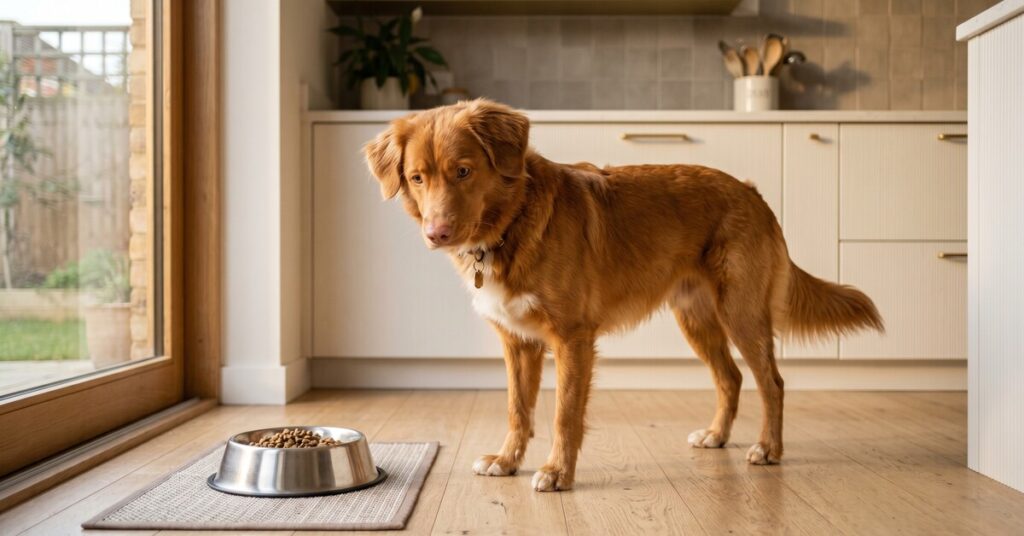
Food transitions in dogs come with a familiar risk. Even when the change is well-intentioned, carefully planned, and executed gradually, some dogs develop loose stool, gas, reduced appetite, or visible digestive discomfort within days of a food switch. The new food gets blamed. The previous food gets reinstated. The dog returns to normal. And the owner concludes that this particular dog simply does not tolerate change.
That conclusion misses the actual explanation. And the actual explanation changes both how you think about food transitions and what you can do to make them significantly smoother.
Why Food Transitions Cause Digestive Upset
The digestive upset that many dogs experience during food transitions is not primarily caused by the new food. It is caused by the gap between the gut microbiome a dog currently has and the gut microbiome required to efficiently process the new food.
Every dog food has a unique composition of proteins, fats, carbohydrates, and fibre substrates. The microbial community in the gut adapts to the specific composition of the food being eaten, developing populations of bacteria that are particularly efficient at fermenting and processing the substrates that food provides. When the food changes, the substrate profile changes.[1]
A microbial community adapted to one substrate profile encounters a significantly different one. The populations most efficient at processing the new substrates are underrepresented. The fermentation process becomes less efficient. The gut has to adapt its microbial composition to the new inputs, and that adaptation takes time. During the adaptation period, the digestive process is less regulated. Loose stool, gas, and general digestive discomfort are the visible signs of that transitional imbalance.[2]
Why Some Dogs Handle Food Transitions Better Than Others
Dog owners often notice significant variation between dogs in how they handle food transitions. One dog transitions smoothly with minimal disruption. Another dog in the same household, eating the same foods, experiences significant upset with every switch. The difference is almost always the gut environment going into the transition.
A dog with a well-supported gut environment has several advantages during a food transition. The beneficial bacterial community is diverse enough to contain populations capable of processing a range of substrate profiles. The environmental conditions, including adequate microbial fuel and a cleared competitive load, support rapid adaptation and population adjustment. The gut lining is intact and regulating the process effectively. The transition disruption is shorter and less severe because the ecosystem has the resilience to adapt.[1]
A dog with a depleted gut environment is significantly more vulnerable during food transitions. Lower microbial diversity means fewer bacterial populations capable of processing unfamiliar substrates. Insufficient microbial fuel means the adaptation process is slower because beneficial bacteria cannot grow and adjust their populations as quickly. An elevated competitive load of heavy metals, toxins, and pathogens means that the transition disruption creates an opening for less beneficial organisms to gain ground. The result is a longer, more uncomfortable transition that confirms the owner’s impression that the dog is highly food-sensitive.[3]
The food sensitivity is real. But it is a consequence of a depleted gut environment rather than an inherent characteristic of the dog.
The Microbiome Mechanics of Food Transition Upset
Understanding what is happening at the microbial level during a food transition helps explain both why upset occurs and what supports a smoother process.
Substrate shift. Each macronutrient in dog food provides different fermentable substrates for the gut microbial community. A shift from a high-protein low-carbohydrate food to one with a different macronutrient profile changes the substrate available to different bacterial populations. Populations that were numerically dominant with the previous food may now be less relevant. Populations that were minor may need to expand significantly. This compositional shift in the microbial community is the primary driver of transition-related digestive upset.[2]
Fermentation gap. During the period when the microbial community is adjusting its composition, fermentation efficiency is reduced. Short-chain fatty acid production, which regulates colonic motility and supports gut lining integrity, temporarily declines. Water regulation becomes less efficient. Gas production from less efficiently processed substrates increases. All of these contribute to the loose stool, gas, and digestive discomfort that characterise transition upset.
Immune activation. The gut-associated immune system interacts continuously with the microbial community and with food-derived compounds. A significant change in both simultaneously, the microbial community shifting and new food compounds arriving, can trigger a degree of immune activation that amplifies the digestive symptoms of the transition. This is more pronounced in dogs with depleted gut environments where immune regulation is already compromised.[1]
Why Gradual Transitions Are Necessary but Not Sufficient
The standard recommendation for food transitions in dogs is a gradual switch over seven to ten days, mixing increasing proportions of the new food with the old. This approach has logic behind it. A gradual substrate shift gives the microbial community more time to adjust its composition incrementally rather than all at once.
But gradual transitions do not address the underlying gut environment that determines how resilient the microbial community is to substrate change. A depleted gut environment with insufficient microbial fuel and an elevated competitive load will struggle with a gradual transition as much as with a rapid one, simply over a longer period. The timeline is extended. The disruption may be less acute. But the underlying vulnerability that produces the disruption has not changed.[3]
For dogs that experience significant transition upset even with gradual switching, the consistent recommendation to try an even slower transition misses the point. The issue is not the speed of the transition. It is the condition of the gut environment going into it.
What Supports a Smoother Food Transition
Supporting the gut environment before and during a food transition addresses the variable that determines how the transition goes.
Supplying adequate bioavailable carbon as microbial fuel gives beneficial bacteria the energy to grow and adjust their populations during the substrate shift. A well-fuelled microbial community adapts to new substrates faster and more completely than a depleted one because the bacteria have the energy to expand the populations that are relevant to the new food profile.
Humic acid works through ionic attraction. Its net negative ionic charge attracts the positively charged heavy metals, toxins, and pathogens that suppress beneficial bacteria and create competitive pressure during the transition. They bind into stable complexes in the small intestine and pass naturally out of the body. Clearing this competitive load before and during the transition reduces the risk that transitional disruption allows less beneficial organisms to gain ground in the gut ecosystem. For the complete science behind how this ionic binding mechanism works, the full guide is at learn.fulgenix.com/humic-acid-dogs-gut.
Fulvic acid is amphoteric, meaning its charge adapts as it moves through the gut’s shifting pH environments. Its small molecular size allows it to cross the gut lining and bind to nutrients and water molecules, supporting their delivery to cells. This supports the gut lining integrity and cellular hydration that keeps the transition disruption from escalating into more significant digestive disturbance.[2]
Fulgenix fuels beneficial bacteria with bioavailable carbon, humic acid binds heavy metals, toxins, and pathogens that cause imbalance, and fulvic acid binds to nutrients and water molecules supporting absorption and cellular hydration.
Dogs with a well-supported gut environment consistently experience shorter, less severe food transitions. Not because the transition is inherently less disruptive, but because the ecosystem has the resilience and the fuel to complete the adaptation process more efficiently.
For dog owners planning a food transition, supporting the gut environment in the weeks before beginning the switch and maintaining that support throughout is the most effective preparation available. The Microbiome Management guide at learn.fulgenix.com covers the full approach, and the Fulgenix Digestive Tract Protector is available at fulgenix.com/products/digestive-tract-protector.
The information in this article is intended for educational purposes only. Fulgenix products are designed to support digestive health and are not intended to diagnose, treat, cure, or prevent disease. Please consult your veterinarian for specific health concerns related to your pet.
Written by Leah Oram, Co-Founder of Fulgenix and The Carbon Biome Project. The Carbon Biome Project advances the understanding of humic and fulvic acid and their role in Microbiome Management across all living systems. Leah brings that science to pet health, helping dog owners move beyond probiotics and understand what the gut environment actually needs to support lasting digestive stability.
FAQ
Why does my dog get diarrhea when I switch food?
Food transition diarrhea in dogs is caused by the gap between the gut microbiome a dog currently has and the one needed to efficiently process the new food. Every food has a unique substrate profile and the microbial community adapts to process it efficiently. When the food changes, the microbial community must adjust its composition. During that adjustment period, fermentation is less efficient, water regulation in the colon is disrupted, and loose stool results. The severity and duration depend on the health of the gut environment going into the transition.
How long should a dog food transition take?
The standard recommendation is seven to ten days for most dogs. However, the duration of the transition period matters less than the condition of the gut environment going into it. A dog with a well-supported gut environment may transition more smoothly in seven days than a dog with a depleted gut environment manages in three weeks. For dogs that consistently experience significant transition upset, supporting the gut environment before and during the switch is more effective than extending the transition timeline alone.
Why does my dog handle food changes worse than other dogs?
Variation in food transition tolerance between dogs is almost always explained by differences in gut environment health rather than inherent individual sensitivity. A dog with a diverse, well-fuelled microbial community adapts to new food substrates faster and with less disruption. A dog with a depleted gut environment lacks the microbial diversity and energy to adapt efficiently. The food sensitivity is a consequence of the gut environment rather than a fixed characteristic of the dog.
Does gradually switching food always prevent stomach upset in dogs?
Gradual transitions reduce the acuity of the substrate shift and give the microbial community more time to adjust incrementally. They are a sensible approach but not sufficient on their own for dogs with depleted gut environments. The adaptation still depends on the microbial community having adequate fuel and operating in a cleared gut environment. If those conditions are absent, a gradual transition still produces disruption, just over a longer period. Supporting the gut environment addresses the underlying variable that determines how well the transition goes.
How can I make food transitions easier for a sensitive stomach dog?
The most effective approach is to support the gut environment before and during the transition rather than focusing solely on the speed of the switch. Ensuring beneficial bacteria have adequate bioavailable carbon as fuel supports faster microbial adaptation. Clearing the competitive load of heavy metals, toxins, and pathogens through humic acid’s ionic binding reduces the risk of opportunistic disruption during the transition period. Supporting gut lining integrity and cellular hydration through fulvic acid maintains the regulatory function that keeps transition disruption from escalating. A dog whose gut environment is well supported going into a food change will experience a shorter, less severe transition than one whose environment is depleted.
References
- Suchodolski, J.S. (2011). Intestinal microbiota of dogs and cats: a bigger world than we thought. Veterinary Clinics of North America: Small Animal Practice, 41(2), 261-272. https://pubmed.ncbi.nlm.nih.gov/21486637/
- Guard, B.C. et al. (2015). Characterization of microbial dysbiosis and metabolomic changes in dogs with acute diarrhea. PLOS ONE, 10(5), e0127259. https://pubmed.ncbi.nlm.nih.gov/25992794/
- Sandri, M. et al. (2017). Raw meat-based diet influences faecal microbiome and end products of fermentation in healthy dogs. BMC Veterinary Research, 13(1), 65. https://pubmed.ncbi.nlm.nih.gov/28253927/